5 Service Lifecycle Trends from PTC NEXT 2026


Jeremy Mittel
Published Date
We spent 3 days at PTC NEXT 2026 attending partner sessions, exploring product roadmaps, and talking with manufacturers, service leaders, and partners. As you likely guessed, AI and connected products dominated many conversations, but some of the most interesting discussions we had focused on Work Plans, Depot Repair, asset intelligence, and the growing connection between product and service lifecycles.
Over the past decade, I've worked with companies across industries to leverage ServiceMax to improve field service operations, increase installed base visibility, optimize service parts planning, connect asset data, and support broader service transformation initiatives. These focus areas have always been interconnected, but they’ve often been treated as separate programs with different owners, priorities, and technologies.
At PTC NEXT 2026, conversations reinforced the need for a more unified approach to service operations:
- AI discussions quickly turned into conversations about how to ensure data quality and governance
- Connected product conversations often led to service execution realities and what asset visibility should look like
- Depot repair discussions expanded into workflow orchestration, service parts, and quality assurance
- Product lifecycle conversations frequently came back to service feedback loops and installed base intelligence
The common thread was industrial companies are looking for better ways to understand, manage, and support the products that are installed in the field.
Here are 5 trends that stood out to me.
1. Work Plans Are Reshaping Service Execution
Historically, work orders have been used to assign and track work. Work Plans take that concept further by defining the individual steps, sequencing, estimated effort, and progress required to complete a task.
Organizations want greater visibility into how work is performed, where delays occur, and whether standard procedures are being followed. Work Plans provide the structure needed to improve execution, scheduling, and reporting.
Several sessions positioned Work Plans as a foundational framework for planning, executing, monitoring, and optimizing service work. Whether work is performed in the field or within a repair depot, organizations want better planning, more accurate progress tracking, improved scheduling decisions, and deeper operational insight.
The future of service management isn’t just about tracking work. It’s about orchestrating how work gets done.
2. Depot Repair Is Becoming a Core Service Operations Capability
Depot Repair was a major focus area, with investments centered on operational visibility, repair orchestration, workstation management, queue management, and standardized repair execution. Much of the innovation focused on bringing greater structure and real-time control to depot operations while strengthening connections to asset history, service parts, warranty processes, and broader service workflows.
Key areas that ServiceMax is innovating in depot repair included:
- Depot work order management
- Work planning and orchestration
- Depot workstations
- Real-time status boards
- Queue management
- Repair prioritization
- RMA and return processes
- Depot-specific reporting and dashboards
What stood out most was how tightly Depot Repair is becoming connected to Work Plans.
Rather than treating repairs as isolated transactions, ServiceMax is creating a structured framework that allows organizations to standardize repair procedures, monitor progress at each stage, and improve throughput across the operation.
The introduction of depot consoles, workstation visibility, status boards, and AI-assisted prioritization reflects a broader shift toward operational control and real-time decision making.
For manufacturers managing service parts, refurbishment programs, warranty repairs, and reverse logistics, Depot Repair is becoming a critical component of service operations.
3. AI Is Moving From Insights to Execution
AI appeared in nearly every roadmap discussion I attended, but the conversation has evolved significantly. The focus is shifting from generating insights to influencing execution through prioritization, scheduling, recommendations, and resource allocation.
PTC showcased investments in ServiceMax AI and intelligent agents designed to support service organizations with:
- Work prioritization
- Scheduling optimization
- Resource allocation
- Service recommendations
- Troubleshooting assistance
- Knowledge access
- Service insights
One example that stood out was AI-driven prioritization within Depot Repair operations. Organizations define their business priorities, and AI helps align work execution against those priorities.
These trends extend beyond traditional field service environments, with solutions like ServiceMax FieldFX helping energy service organizations connect field execution, asset data, and operational processes.
The companies that benefit most from these capabilities will still need strong data foundations, but the direction is clear. AI is moving closer to day-to-day service execution.
4. PTC Orbit Signals a New Era of Asset Intelligence
One of the most notable announcements from the event was PTC Orbit, a new asset intelligence platform designed to help organizations unify, cleanse, and activate asset data across the enterprise.
For years, manufacturers have struggled with information spread across multiple systems.
- Engineering data lives in PLM
- Operational data lives in ERP
- Customer information lives in CRM
- Service history lives in FSM
- Connected asset data lives in IoT platforms
Orbit is designed to create a trusted asset data foundation by consolidating, cleansing, validating, and reconciling information from disconnected systems such as PLM, ERP, CRM, FSM, IoT platforms, and legacy enterprise applications. The goal is to provide a single source of truth for deployed assets that can be used across engineering, service, operations, and business teams.
With that foundation in place, organizations can gain deeper insight into:
- Asset performance and health
- Service history and maintenance activity
- Installed asset visibility
- Failure trends and reliability analysis
- Demand forecasting and service planning
- Asset risk and operational readiness
Several sessions reinforced the growing demand for this type of visibility. Organizations want a more complete understanding of how products perform once they’re deployed in the field.
Orbit reflects a broader industry shift toward asset intelligence, where trusted data becomes the foundation for better decisions across engineering, service, operations, and aftermarket organizations.
5. Product and Service Lifecycles Are Finally Converging
One of the most strategic themes at the event was the continued convergence of product and service lifecycles.
A topic that surfaced repeatedly during roadmap discussions was the growing connection between ServiceMax and Windchill. For years, customers have asked for a stronger link between engineering and service data. Based on the roadmap discussions, PTC is investing in a deeper out-of-the-box connection designed to improve how information moves between the two platforms.
The vision includes tighter alignment across:
- Product structures
- Service BOMs
- Engineering changes
- Service instructions
- Installed products
- As-maintained asset hierarchies
- ERP and as-built information
The goal is to create a more continuous feedback loop where engineering can better understand how products perform in the field and service teams can work from the latest product information and design updates.
For organizations focused on Service Lifecycle Management (SLM), this represents an important step toward connecting product, asset, and service data throughout the lifecycle. Better alignment between Windchill and ServiceMax can help improve installed base visibility, strengthen asset intelligence initiatives, support service parts planning, and provide a more complete view of the customer and asset relationship.
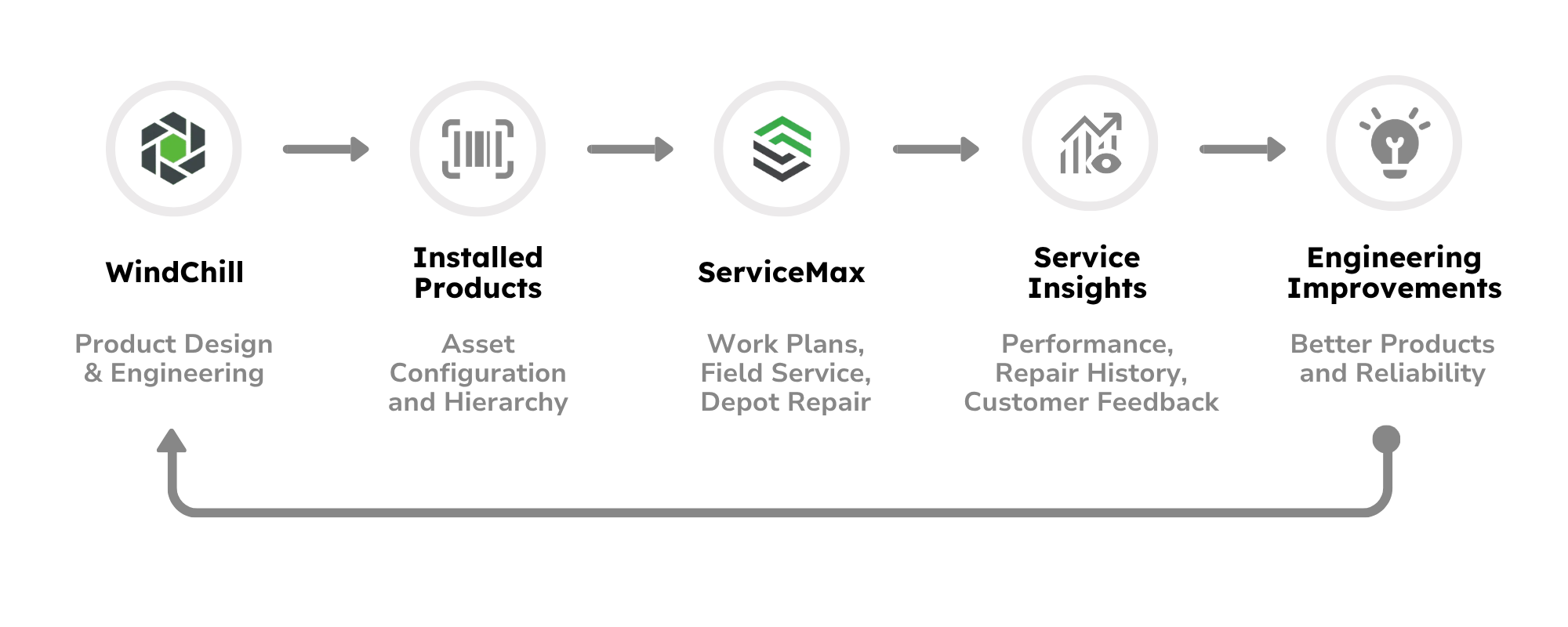
This matters because service organizations often have valuable insight into how products perform in real-world environments. Historically, that information hasn’t always made its way back into product design decisions.
As service data becomes more connected to engineering, organizations gain new opportunities to improve product quality, reduce service costs, accelerate innovation, and deliver better customer experiences.
Final Thoughts
Looking across the sessions, roadmaps, and product announcements, it became clear that service is becoming a more strategic part of the product lifecycle.
Whether through Work Plans, Depot Repair, AI, asset intelligence, or tighter integration between ServiceMax and Windchill, the focus is shifting toward greater visibility, better execution, and stronger connections across the lifecycle.
At Bolt Data, we’ve seen these priorities firsthand through field service, installed base management, connected assets, depot repair, and service transformation initiatives. PTC NEXT reinforced that the service organizations creating the most value are building connected service operations that can evolve alongside their products and customers.
If your organization is evaluating how these trends could impact your service strategy, let’s continue the conversation.