The Service Experience is *Still* Broken
.png)

Cris Grody
Published Date
Let’s start with something everyone has lived through.
You need something serviced. Not a “maybe service,” not “when we get around to it,” but real service because something is down, something is unsafe, or something is costing you money by the hour.
So you call the main customer service help line.
You get a phone tree. You press 1, then 4, then 2, then you repeat yourself to a new customer service agent because the first “doesn’t handle scheduling.” You finally get an appointment window that’s sometime between 7:00AM to 7:00PM. Then the technician finally shows up… without the right part. Or without any context. So now you need another appointment. Another 12-hour window. Another round of explaining. Another delay.
That is not a customer experience. That is friction, dressed up as a process.
It’s not just frustrating. It’s expensive.
The Real Problem Isn’t the Technician, It’s the System Around Them
Most service organizations do not have a “people problem.” They have a workflow and visibility problem.
Here’s where things tend to break down in the real world:
- Scheduling is Disconnected from Reality: The schedule is built on partial information, outdated assumptions, and guesswork. Customers get wide windows because the system cannot confidently commit.
- The Customer Has to Do the Work: Customers chase updates, confirm details, and coordinate access because the business cannot provide clear, proactive communication.
- Technicians Roll Up Blind: If equipment history, past work orders, entitlements, and known issues live in different systems, the field team shows up missing context.
- Parts and Inventory Aren’t Tied to the Job: When inventory visibility is weak, the tech arrives without what they need. Not because they don’t care, but because the system never put them in a position to win.
- Every Handoff Adds Delay: Contact center to dispatch, dispatch to field, field to depot, depot to shipping. If each step runs on a different tool, the “simple” case becomes a multi-day mess.
This is why service feels broken. It is a bunch of separate systems pretending to be one experience.
Why This Keeps Happening Even Today
A lot of companies are still operating on a patchwork.
They have an ERP. A CRM. A field service tool. A customer service tool. A scheduling add on. A separate system for order management. A data lake for telemetry. A BI layer to make reports that tell you what went wrong after the fact.
Each system does its job… kind of. However, no one owns the end to end service experience across the full lifecycle.
When those systems don’t share a common model, the work becomes manual. People end up reconciling reality across tools, spreadsheets, and tribal knowledge. That’s how you get long appointment windows, repeated calls, and multiple visits.
What it Takes to Have Great Service Delivery
This is where a platform approach matters. Not for buzzwords, but because customers experience the seams between tools.
ServiceNow’s CRM approach is compelling because it brings the core service motions together:
- CSM (customer service management) for the front door, intake, case visibility, and customer updates
- FSM (field service management) for dispatch, scheduling, work execution, and technician enablement
- SOM (service order management) for the order lifecycle, entitlements, fulfillment, and coordination across teams
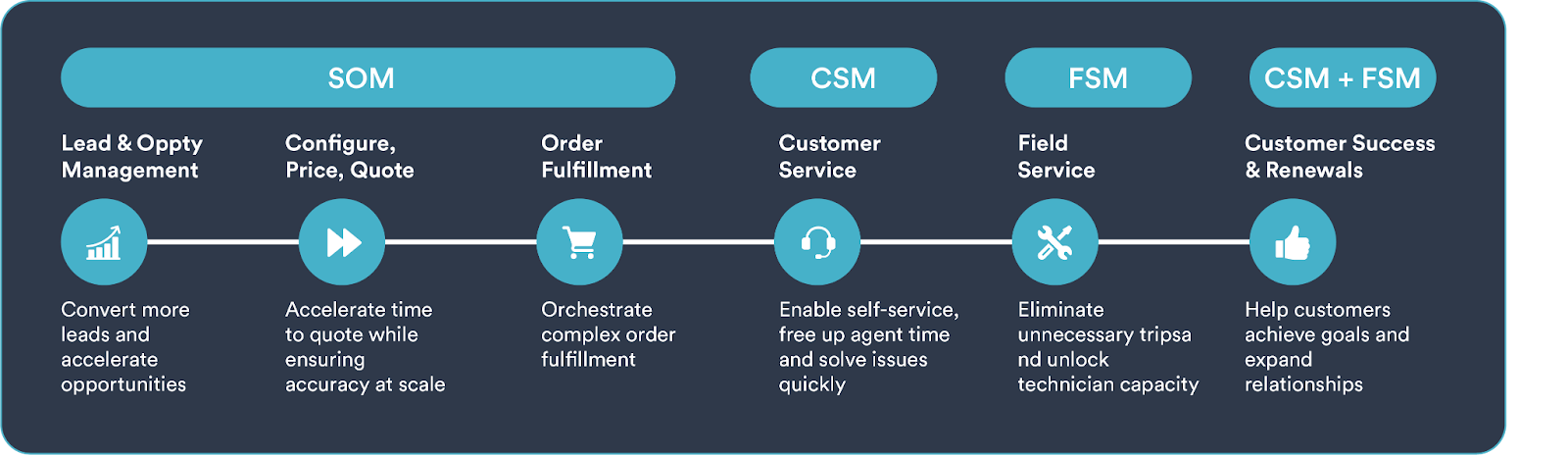
ServiceNow’s CRM Platform Unifies Field, Customer and Sales Teams
When those motions run on one platform and one data model, you get a different outcome:
- Customers can schedule and track service like they track everything else in their life. If you can track a seven dollar pizza, you should be able to track a technician for a multi thousand dollar service call.
- Contact center, dispatch, and field all see the same truth. No more “let me transfer you.” No more “we don’t have that information.” No more starting over.
- Technicians show up with context and the right plan. Asset history, known issues, parts availability, and customer expectations are connected to the work order, not scattered across systems.
- Fewer repeat visits because the job is prepared correctly. First time fix improves when the system actually supports first time fix.
And no, this does not require turning your whole world upside down on day one. The smartest approach is crawl, walk, run. Start where friction is highest, prove value, then expand. For many organizations, that means establishing core service capabilities first and then layering on additional processes, automation, and integrations as the business matures.
What Customers Want is Pretty Simple
Customers are not asking for magic.
They want clear communication. Shorter windows. Fewer calls. Fewer repeat visits. Techs who show up prepared. A service experience that feels modern, not stuck in 2005.
If that sounds obvious, good! It should be.
The hard part is fixing the system behind it.
Pressure Test Your Current Service Experience
If you want to talk through what’s broken in your current service journey and where a unified approach with ServiceNow CRM (FSM, CSM, SOM) could remove real friction without turning into a “rip and replace” project, book time with our team.
Bring one or two real service scenarios. We will map the friction, identify quick wins, and outline a crawl, walk, run path that actually moves the needle.