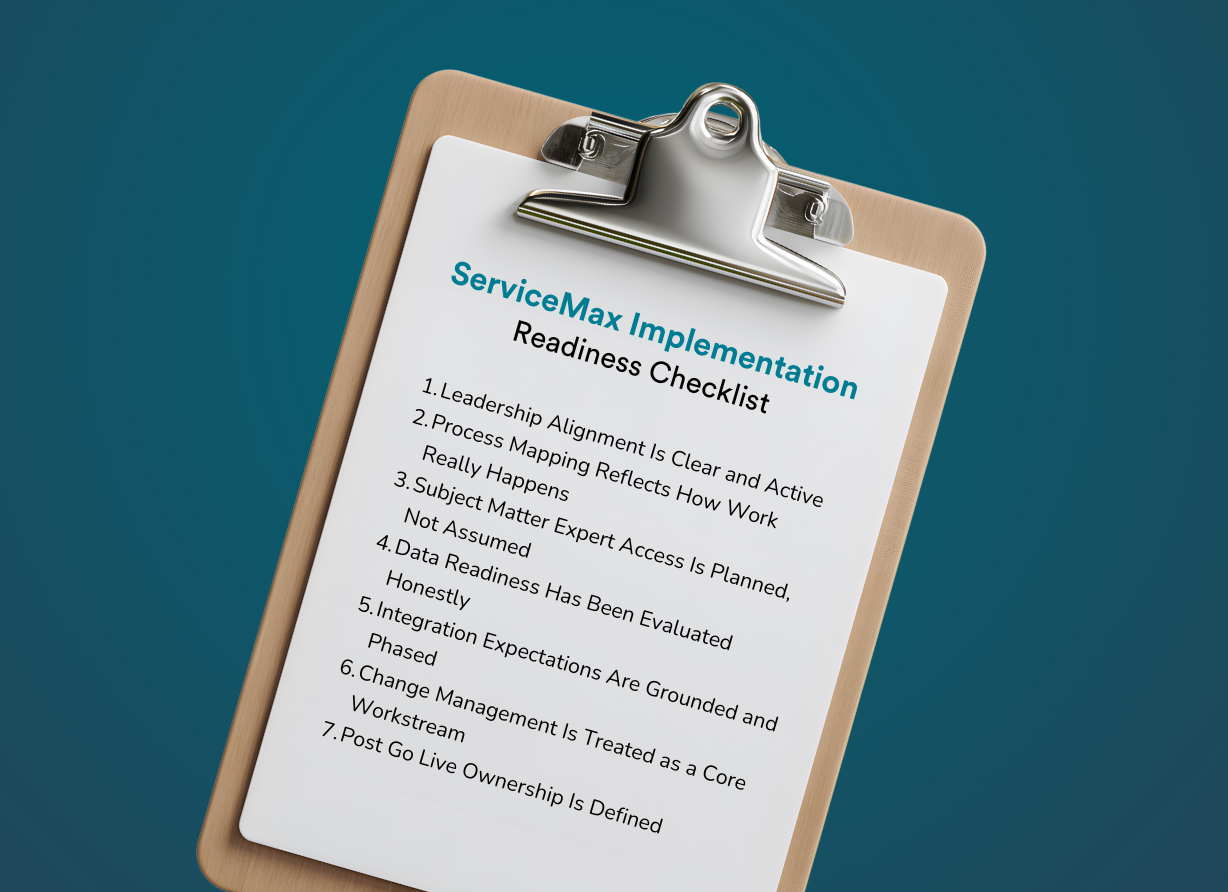
The ServiceMax Implementation Readiness Checklist

David Campbell
Published Date
Most successful ServiceMax implementations share a simple trait. The organization paused long enough to make sure it was ready before moving forward.
Having spent years working directly with ServiceMax implementations, both inside ServiceMax and alongside customers, one pattern shows up consistently. The platform itself is rarely the limiting factor. What determines success is clarity. Clarity around what the business is trying to improve, how teams actually work today, and what it will take to bring people along for the change.
When those foundations are in place before signing, delivery is smoother, decisions happen faster, and adoption feels far less painful.
This checklist is meant to help service leaders assess readiness early, while there is still room to adjust scope, expectations, and ownership.
1. Leadership Alignment Is Clear and Active
Every ServiceMax implementation, whether it’s ServiceMax Core, FieldFX, or Asset 360, still needs a clear point of view from leadership on what the business is actually trying to change.
Before signing an SOW, leaders should be able to answer a few straightforward questions:
- What are we trying to improve in our service organization?
- What problems are we solving that our current tools can’t solve?
- What does success look like once the system is live?
When leadership is aligned, decisions move quickly and teams stay focused. When that alignment is missing, priorities get debated, users push back on change, and momentum slows.
Clear, engaged executive sponsorship is what keeps decisions moving and prevents the project from stalling.
2. Process Mapping Reflects How Work Really Happens
ServiceMax will quickly highlight where processes break down. That is expected. What matters is whether teams are honest about how work actually gets done today.
Before kickoff, there should be shared understanding around:
- Core service workflows from intake through completion
- Common exceptions and workarounds that exist today
- Which processes will change now and which will evolve later
Designing around an ideal future state without grounding it in reality often leads to rework. A process that looks clean in a workshop can fall apart in the field.
If you start with reality, you avoid rework later. That’s what keeps implementations moving forward.
3. Subject Matter Expert Access Is Planned, Not Assumed
One of the fastest ways for an implementation to stall is losing access to the right people at the wrong time.
Field service teams are busy by nature. Technicians are in the field. Managers are focused on daily operations. If SME involvement is not planned, it becomes difficult to get meaningful input once delivery pressure increases.
Before signing, confirm:
- Who the key subject matter experts are
- When they will be involved and for which decisions
- How their feedback will be captured and incorporated
You don’t need large groups. You need a small set of experienced voices who understand the business and can represent how work happens in the field.
That input early prevents major course corrections later.
4. Data Readiness Has Been Evaluated Honestly
You can design solid workflows and automation, but unreliable data undermines everything built on top of it.
Before committing to scope, organizations should take an honest look at:
- Accuracy and completeness of asset and installed base data
- Consistency of parts, pricing, and service history
- Ownership of data cleanup and ongoing governance
ServiceMax amplifies whatever data you put into it. When data is messy, reporting becomes questionable, scheduling decisions suffer, and users stop trusting the system.
Data readiness is not something to fix after going live. It needs up front attention.
5. Integration Expectations Are Grounded and Phased
It is common to assume every integration needs to be built immediately. In reality, that often adds complexity without delivering early value.
Before signing an SOW, teams should align on:
- Which integrations are required on day one
- Which can wait until the core foundation is stable
- What truly needs to integrate versus what can be phased later
Starting with essentials like pricing, inventory, or ERP is typical. More advanced integrations, analytics, or AI enablement can follow once the system is established.
A phased approach keeps the implementation focused and moving forward.
6. Change Management Is Treated as a Core Workstream
Change management is not a side task. It is one of the biggest drivers of success.
Field service teams are often distributed and work independently. If users aren’t brought into the process at the right moments, feedback tends to arrive late, usually after go-live.
Before kickoff, confirm:
- Who owns change management internally
- How end users will be involved throughout the project
- How the reason behind changes will be communicated
Explaining the meaning behind the clicks matters. When users understand why a change is happening and how it supports them, adoption follows. When they do not, resistance builds.
7. Post Go Live Ownership Is Defined
Go live is not the finish line. It is the start of real usage. Organizations should be clear about:
- Who will administer and support the system internally
- How enhancements and fixes will be prioritized
- What ongoing support model is in place
Many teams benefit from managed services after launch, especially when internal admin capacity is limited or when enhancements are expected quickly.
Without a post go live plan, value tends to stall.
Final Check Before You Sign
A statement of work locks in more than scope and timeline. It locks in assumptions.
Taking time to validate readiness before signing reduces risk, protects budget, and creates shared understanding across business, service, and delivery teams. When alignment, data, access, and ownership are clear, ServiceMax becomes an accelerator instead of a hurdle.
That is what readiness really looks like.
Get a Second Set of Experienced Eyes on Your Plan
We work with service teams to surface risks, uncover opportunities, and clarify priorities early, before scope and timelines are locked.
Download our ServiceMax implementation readiness checklist and set up time with our team to walk through your approach to make sure you are starting from solid ground.